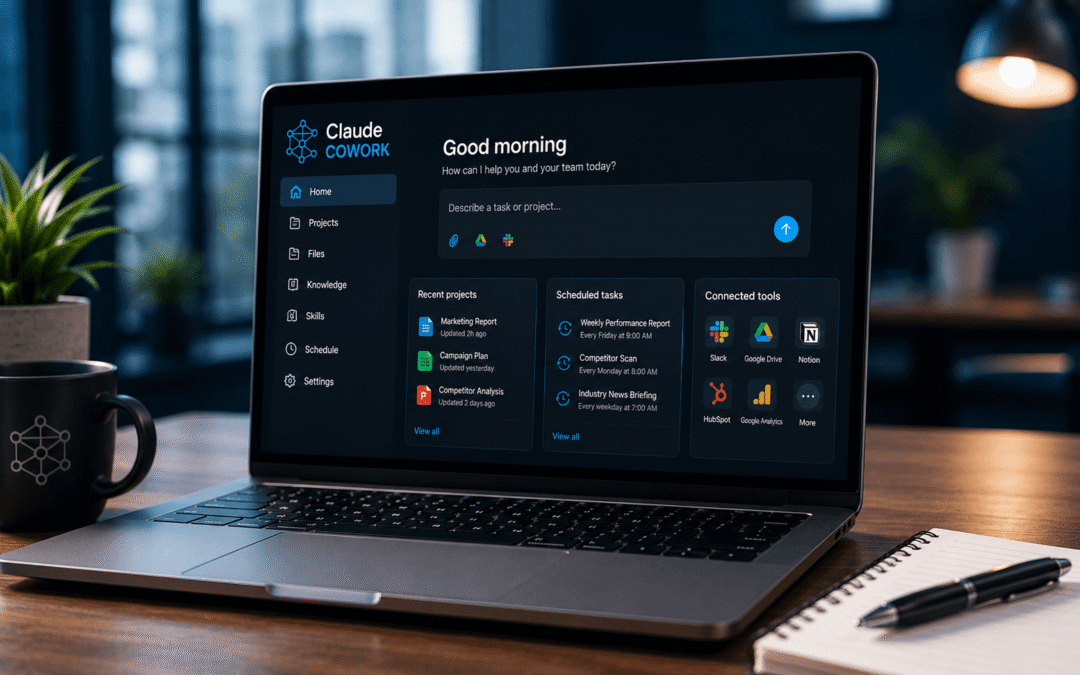
Most AI tools are advisors. You ask, they answer, then you still do the work. Claude Cowork for marketing flips that model. Anthropic’s agentic desktop AI doesn’t just suggest the campaign brief, the competitive teardown, or the weekly performance report — it opens your files, talks to your tools, and delivers the finished work while your team focuses on strategy, clients, and revenue.
For marketing teams, agencies, and growth-minded business leaders, that distinction is everything. The bottleneck in modern marketing isn’t ideas — it’s execution. Claude Cowork closes that gap.
What Is Claude Cowork
Claude Cowork is Anthropic’s desktop AI agent, released to all paid Claude plans in early 2026. It runs inside the Claude Desktop app on Mac and Windows and operates directly on the local files, folders, and applications your team already uses — Slack, HubSpot, Notion, Google Workspace, Microsoft 365, and dozens more through MCP (Model Context Protocol) connectors.
Unlike Claude Chat, which answers questions inside a conversation window, Cowork has permission to read, edit, and create files in folders you specify. Give it a goal, and it figures out the steps, executes across tools, and returns a finished deliverable — a Word document, a spreadsheet, a slide outline, a Slack message, a structured report.
It’s built on the same agent architecture as Claude Code, the developer tool that quietly became one of Anthropic’s most-used products. The difference is that Cowork removes the terminal, the API keys, and the technical setup. If you can describe a task in plain English, you can run Cowork.
Why Claude Cowork for Marketing Matters Right Now
The 2025 marketing stack was bloated with single-purpose AI tools — one for copy, one for images, one for analytics, one for outreach. Every one of them produced output you still had to format, edit, and shoehorn into your real workflow.
Cowork collapses that stack. It isn’t another point solution; it’s a co-worker that uses your existing tools the way your team already uses them.
Three shifts are driving rapid adoption inside marketing teams, agencies, and operations groups:
From advice to execution. Most AI chatbots stop at recommendations. Cowork ships deliverables — real spreadsheets, real decks, real emails — into the folder or channel where you need them.
From single tasks to chained workflows. A typical marketing workflow touches five or six tools. Cowork can read a CSV, cross-reference your CRM, pull web data, write a report, and post a summary to Slack in one continuous pass.
From manual triggers to scheduled automation. With the /schedule command, Cowork runs recurring jobs (weekly competitor scans, daily news briefings, monthly performance reports) without anyone touching it.
Eight High-Leverage Use Cases for Marketing and Business Teams
These are the workflows where we are seeing the biggest impact for clients adopting Claude Cowork at Prime Concepts Group.
Competitive Intelligence Briefs. Drop competitor PDFs, screenshots, and saved web pages into a folder. Cowork synthesizes a gap-analysis table showing where rivals are winning, where they are weak, and which content topics you should claim.
Content Repurposing at Scale. One long-form blog becomes a LinkedIn post, an email sequence, three social captions, and a podcast outline — all matched to your brand voice through a “Skill” file you build once and reuse forever.
Campaign Brief Automation. Hand Cowork a product description, a target persona, and a past campaign. It returns a complete campaign plan with messaging pillars, channel mix, creative direction, and a draft launch sequence.
Performance Reporting on Autopilot. Schedule a Friday job that pulls Google Analytics, Meta Ads, and HubSpot data, formats the numbers, flags anomalies, and drops a finished report into a shared Slack channel — every week, with zero human input.
Lead Research and Outbound Drafting. Combine a CRM export with web research and generate personalized outreach drafts for every prospect, ready for human review before sending.
SEO and GEO Audits. Feed it your site, competitor sites, and a keyword list. Get back content gaps, on-page recommendations, and AI-citation opportunities (Generative Engine Optimization) in a single deliverable.
Customer Feedback Synthesis. Drop hundreds of survey responses or call transcripts into a folder. Cowork clusters themes, surfaces top complaints, and produces a structured insight report your product and marketing teams can act on.
Operational Cleanup. Organize a chaotic Downloads folder, rename a thousand client assets, standardize file structures across team drives — the unglamorous work that quietly drains hours every week from every team.
The marketing examples lead because that is where most teams will see the fastest ROI. But the real lesson is broader: any knowledge work that involves files, repetition, and multiple tools is a fit. That includes finance, legal, operations, customer success, sales, and HR — which is why forward-thinking businesses are rolling Cowork out across the entire organization, not just the marketing team.
How Claude Cowork Compares to Claude Chat and Claude Code
For most marketing teams, Cowork is the right starting point. Once technical staff get involved, Cowork and Code work together brilliantly.
How to Get Started With Claude Cowork
Install the Claude Desktop app for Mac or Windows on any paid plan. Pro at $20/month is enough to start. Teams running heavy workflows will eventually move to Max for higher usage limits.
Switch to the Cowork tab at the top of the app.
Grant access to one non-sensitive folder. Treat it as a sandbox where Cowork can read and write while the rest of your system stays off-limits.
Build a Brand Voice Skill. This is a plain-English file describing your tone, banned phrases, audience, and examples of good and bad copy. Cowork loads it on every task and keeps every output on-brand.
Automate your first recurring task with the /schedule command. Start with a weekly competitor scan or a Monday performance summary.
Layer in connectors (Slack, Google Drive, HubSpot, Notion) as your workflows mature and your team builds trust in the outputs.
Three Mistakes to Avoid
Skipping context setup. Cowork is only as good as the context you give it. Invest thirty minutes building an “About” folder with your ideal customer profile, brand voice, and positioning before you run a single serious workflow. Context engineering beats prompt engineering every time.
Granting too much folder access too soon. Start scoped. Expand only after you trust the outputs and have reviewed a few deliverables end-to-end.
Treating Cowork like a strategist. It executes brilliantly. Direction, judgment, brand vision, and creative leadership still belong to you and your team. Cowork eliminates busy work — it does not replace strategic thinking.
Frequently Asked Questions
What is Claude Cowork for marketing? Claude Cowork is Anthropic’s desktop AI agent that executes marketing tasks — reports, briefs, content drafts, data analysis, outreach — by reading the files you authorize and operating the tools you connect. It delivers finished work, not just suggestions.
How is Claude Cowork different from Claude Chat? Chat responds to messages inside a conversation. Cowork takes action. It reads, edits, and creates files in folders you approve, and it can run scheduled jobs without supervision.
Do I need coding skills to use Claude Cowork? No. If you can write a Notion page and describe what you want in plain English, you can run Cowork productively from day one.
Is my marketing data secure with Claude Cowork? Cowork only accesses folders and connectors you explicitly grant. For sensitive customer data, work with anonymized samples until your compliance team signs off on production records.
How much does Claude Cowork cost? Cowork is included on every paid Claude plan, starting at $20/month for Pro. Heavy users typically move to Max ($100/month) for higher usage limits.
Can Claude Cowork replace my marketing team? No, and that is the wrong question. Cowork eliminates the busy work that drains marketers’ time so your team can spend more hours on strategy, creative, and client relationships — the work that actually grows the business.
Put Claude Cowork to Work for Your Business
The companies winning in 2026 are not the ones with the most AI tools. They are the ones with the right AI workflows. Claude Cowork is one of the biggest productivity unlocks of the year, and most teams are using less than ten percent of what it can do.
That is where Prime Concepts Group comes in.
We help business leaders, marketing teams, franchise organizations, and growth-minded companies integrate AI tools like Claude Cowork into the workflows that actually drive revenue. Whether you need hands-on AI training for your team, agency support to build and launch your campaigns, or strategic guidance on where to deploy AI first for the biggest return, we are ready to help.
Stop watching the AI revolution from the sidelines. Put it to work.
Contact Prime Concepts Group today for AI training, marketing support, and business growth strategies built around tools like Claude Cowork.
AI Event for Business Leaders 2026 options are everywhere. Conferences, summits, webinars, and workshops promise insight and transformation. Yet many leaders walk away with more ideas than action and more tools than clarity.
The issue is not a lack of information. The issue is focus.
An AI Event for Business Leaders 2026 is only worth attending when it is built around business outcomes. Otherwise, it becomes a highlight reel of tools you will not implement, tactics your team will not adopt, and trends that shift before you can act.
Why Leaders Leave AI Events Overwhelmed
Most AI events fail business leaders for one simple reason. They confuse technology exposure with business progress.
Leaders do not need more demos. Leaders need decisions.
If an event does not help you improve growth fundamentals like visibility, lead quality, sales velocity, and operational efficiency, it is entertainment, not transformation.
What an AI Event for Business Leaders 2026 Should Deliver
Before you commit your time, budget, and attention, use this checklist. It will quickly separate hype from value.
1. The Event Must Be Built Around Growth Outcomes
Ask directly. Does this event focus on growth or does it focus on tools?
Tools change fast. Growth principles remain.
The best AI Event for Business Leaders 2026 will connect AI to measurable outcomes such as:
Lower acquisition costs
Higher lead quality
Faster sales cycles
Better customer retention
Improved operational efficiency
If those outcomes are not clearly defined, the event is not designed for leadership decisions.
2. It Must Address the AI Influenced Buying Process
AI now shapes how buyers research, compare, and narrow options before they ever talk to sales.
That is why demand generation is changing and why costs are rising for teams that do not adapt.
The right AI Event for Business Leaders 2026 will force practical decisions such as:
What AI should improve in your business first
What you will stop doing because it no longer works
What your team needs to implement responsibly
How you will measure success in the next 30 to 90 days
If there is no structured path to implementation, you will return to your inbox and nothing will change.
4. It Must Respect Leadership Judgment
AI is powerful. Leadership is still the advantage.
Events that imply automation replaces thinking create risk. The best events show you how to use AI to improve decisions, reduce friction, and strengthen accountability.
Why In Person Working Sessions Outperform Conferences
In person working sessions create something most leaders do not have right now. Focus.
Conferences give you content. Working sessions give you clarity, context, and accountability.
An AI Event for Business Leaders 2026 is far more valuable when it is designed for:
Real time planning
Peer level conversations
Guided application to your organization
Decision making with clear next steps
When you remove distractions and work on the business instead of in the business, you leave with a plan your team can execute.
What to Ask Before You Register
Use these questions to protect your time and ensure the event matches your role.
Will I leave with a clear implementation plan?
Does this event connect AI to revenue, not just productivity?
Is it built for business leaders, not only technical teams?
Does it address marketing, sales, and operations together?
Will it help me make decisions I can act on immediately?
If the answers are unclear, your ROI will be unclear too.
Why the Business Growth AI Summit Was Built for Leaders
The Business Growth AI Summit was designed as an AI Event for Business Leaders 2026 who want clarity, not hype.
This is not a sit and listen conference. It is a working session built around applying AI to the fundamentals that drive performance.
Leaders attend to align AI with outcomes like:
Visibility and authority in an AI driven discovery environment
Lead quality and relevance over volume
Sales acceleration by reducing friction and improving follow up
Operational efficiency with accountability and judgment intact
If you want a clear path to apply AI responsibly and profitably, explore the summit details at ProfitRichResults.com/AISummit
Next Step
If you are evaluating an AI Event for Business Leaders 2026, make it simple. Choose the event that helps you make decisions and build an execution plan.
Then commit to action while competitors are still collecting notes.
When you are ready to take AI from idea to implementation, the Business Growth AI Summit is where clarity happens.
Cost Per Lead 2026 is one of the most urgent conversations happening in executive meetings right now.
Many leaders are asking the same question. Why does generating leads feel harder and more expensive than it used to, even with better technology, better platforms, and more automation?
The answer is not that marketing stopped working.
Buyer behavior changed.
Artificial intelligence now shapes how prospects research, compare options, and narrow their choices long before they speak to a salesperson. AI driven summaries, recommendation engines, and intelligent search results influence perception at the earliest stage of decision making.
If your organization has not adapted to this reality, you are likely compensating by spending more.
More ads.
More platforms.
More tools.
The result is higher Cost Per Lead 2026 and lower conversion quality.
Why Cost Per Lead 2026 Keeps Increasing
There are four primary reasons Cost Per Lead 2026 continues to rise.
1. AI Filters Before Buyers Click
AI driven discovery systems now pre qualify vendors before prospects ever visit a website. If your positioning is unclear or undifferentiated, you are filtered out early.
You pay more to reach fewer qualified buyers.
2. Volume Based Marketing Is Breaking Down
For years, many organizations relied on increasing traffic to offset inefficiencies.
In 2026, AI rewards relevance, not volume.
If your message does not align with buyer intent, more traffic simply increases wasted spend. That drives Cost Per Lead 2026 even higher.
3. Buyer Skepticism Is Increasing
Buyers have access to more information than ever. They are not looking for more content. They are looking for confidence.
If your messaging creates confusion instead of clarity, prospects hesitate. Longer decision cycles increase acquisition costs.
4. Marketing and Sales Misalignment
When marketing optimizes for form fills and sales optimizes for revenue, lead quality suffers.
Cost Per Lead 2026 is not just a marketing metric. It is a revenue performance issue.
What Growth Leaders Are Doing Differently
The organizations seeing stronger results are not chasing every new AI tool. They are redesigning how they show up in the market.
Here is how they are reducing Cost Per Lead 2026.
They Clarify Positioning
Clear positioning attracts the right prospects and repels the wrong ones.
When your message speaks directly to buyer intent, AI systems amplify precision instead of noise.
This reduces wasted impressions and improves conversion rates.
They Strengthen Authority Signals
AI evaluates expertise signals across your digital footprint.
Growth focused leaders invest in:
Expert driven content
Consistent messaging
Clear value articulation
Structured thought leadership
Authority reduces friction. Reduced friction lowers Cost Per Lead 2026.
They Shorten the Sales Cycle
Buyers want clarity.
Organizations that simplify their messaging, streamline follow up, and eliminate unnecessary steps move prospects through the pipeline faster.
When velocity increases, acquisition cost per closed deal decreases.
They Use AI Strategically Instead of Tactically
AI should support strategy, not replace it.
High performing organizations use AI for:
Predictive segmentation
Behavioral targeting
Lead scoring refinement
Follow up optimization
They do not implement AI for novelty. They implement it to improve measurable performance.
The Real Question Behind Cost Per Lead 2026
Instead of asking, how do we get more leads, smart leaders ask a better question.
AI Business Strategy 2026 is no longer a future conversation. It is a present competitive advantage.
Artificial intelligence is reshaping how buyers research, how prospects compare options, and how leaders make decisions. The question is no longer whether to adopt AI. The real question is this:
How do you use AI to increase revenue, improve efficiency, and strengthen leadership without creating noise, risk, or confusion?
After working with organizations across industries for decades, one pattern is clear. The companies winning with AI are not chasing tools. They are strengthening the fundamentals that have always driven growth.
Here are the four pillars defining AI Business Strategy 2026.
1. AI Business Strategy 2026 and Visibility
Visibility now happens before a buyer ever fills out a form.
AI systems summarize brands. Recommendation engines narrow options. Search results are increasingly influenced by generative AI answers.
If your positioning is unclear, inconsistent, or generic, you get filtered out before a conversation even begins.
Leaders using AI Business Strategy 2026 are optimizing:
Authority positioning
Structured expertise signals
Clear and consistent messaging
Content designed for AI-driven discovery
They ask a better question.
Not, how do we rank?
But, how do we become the most understandable and referable option in an AI influenced market?
That shift increases discoverability and perceived credibility simultaneously.
2. AI Business Strategy 2026 and Lead Quality
Many businesses are seeing more activity but fewer qualified buyers.
AI amplifies whatever message you feed it. If your messaging lacks clarity, AI increases noise. If your positioning aligns with real buyer intent, AI increases precision.
Smart leaders are using:
Intent-based targeting
Predictive audience modeling
AI-assisted segmentation
Behavioral data analysis
The result is not just more leads. It is better-fit prospects who move faster through the buying process.
When AI aligns with buyer intent, cost per acquisition decreases and conversion quality improves.
3. AI Business Strategy 2026 and Sales Acceleration
AI should shorten the sales cycle.
When implemented strategically, AI Business Strategy 2026 improves:
Follow-up timing
Objection anticipation
CRM insights
Pipeline prioritization
Sales teams gain clarity instead of more dashboards.
The outcome is faster decisions, reduced friction, and increased close rates.
Technology that complicates selling erodes trust. Technology that simplifies selling accelerates revenue.
4. AI Business Strategy 2026 and Operational Efficiency
AI is transforming operations, but leadership judgment remains irreplaceable.
Smart organizations use AI to:
Automate repetitive workflows
Monitor risk signals
Improve forecasting
Enhance accountability
AI removes inefficiency. Leadership preserves responsibility.
Companies that treat AI as a replacement for thinking create risk. Companies that treat AI as an accelerator of disciplined execution create margin expansion.
Common Mistakes Leaders Are Making With AI
Even strong organizations struggle when they:
Stack tools without strategy
Delegate judgment to automation
Ignore data quality
Focus on hype instead of outcomes
Implement AI without training their people
AI Business Strategy 2026 requires clarity of purpose.
AI does not replace leadership. It demands stronger leadership.
Where to Apply AI Business Strategy 2026 in Your Organization
Leaders attending the Business Growth AI Summit work through:
Demand generation redesign
AI influenced buyer journeys
Sales acceleration systems
Operational clarity frameworks
Leadership alignment in an AI environment
This is not a conference filled with hype. It is a working session designed for business leaders who want practical application.
If you are serious about using AI to increase revenue and strengthen long term performance, the Business Growth AI Summit gives you a clear path forward.
An Amazon direct review link is one of the simplest and most underutilized tools sellers can use to increase product reviews without violating Amazon policies. When implemented correctly, this strategy reduces friction, improves follow-through, and strengthens trust across your entire product listing.
Most customers are willing to leave feedback. They just do not want to hunt for the review button.
By guiding buyers directly to the review submission page, sellers remove unnecessary steps and dramatically improve participation.
This article breaks down how to use an Amazon direct review link from a marketing perspective, not just a technical one.
What Is an Amazon Direct Review Link
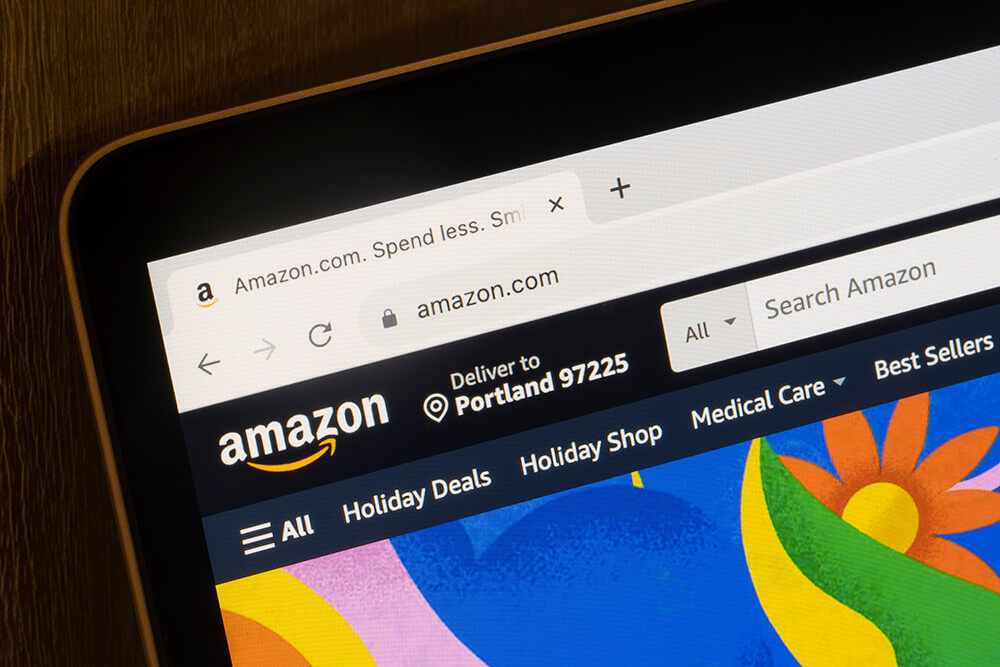
An Amazon direct review link sends customers straight to the review creation page for a specific product. Instead of navigating through order history and menus, buyers land exactly where the action happens.
From a marketing standpoint, this functions like a conversion-optimized landing page. Fewer steps equals higher completion rates.
Amazon has reduced friction by allowing star-only ratings, but sellers still need to actively guide customers to that moment.
Why an Amazon Direct Review Link Impacts Sales
An Amazon direct review link influences performance in three major ways.
Improves Organic Visibility
Amazon’s algorithm favors listings with consistent review activity. More reviews signal relevance and buyer trust.
Increases Conversion Rates
Social proof reduces hesitation. Listings with higher review counts convert better than similar products with fewer reviews.
Builds Buyer Confidence
Every review reinforces credibility. Over time, reviews compound into brand authority.
The Amazon direct review link does not create fake demand. It unlocks feedback from satisfied customers who already exist.
How to Create an Amazon Direct Review Link
Creating an Amazon direct review link is straightforward.
Use this structure: www.amazon.com/review/create-review?&asin=YOUR_ASIN_HERE
Replace “YOUR_ASIN_HERE” with your product ASIN or ISBN-10. Do not use ISBN-13.
This link sends customers directly to the review submission screen.
For mobile optimization, tools like URLgenius help ensure the Amazon direct review link opens inside the Amazon app instead of a browser.
Where to Use an Amazon Direct Review Link
Using an Amazon direct review link correctly is just as important as creating it.
Product Inserts
Include a QR code that leads to your Amazon direct review link. Position it as a thank-you, not a request for positivity.
Post-Purchase Email Campaigns
If customers opted into your email list outside of Amazon, send a short follow-up requesting honest feedback.
Thank You Pages
After a customer completes a purchase through an external campaign, direct them to a thank-you page with your Amazon direct review link.
Paid Retargeting
Run ads to past purchasers reminding them to share their experience. These audiences already trust your brand.
Internal Link Opportunity: Link to a related post on post-purchase email automation or customer retention strategy.
Do not offer incentives, discounts, or rewards. Do not ask for positive reviews specifically. Do not send custom review links through Amazon’s buyer-seller messaging system. Do not include external URLs inside reviews.
For in-platform requests, always use Amazon’s Request a Review button.
Best Practices for Amazon Direct Review Links
Timing Matters: Send review requests 5 to 30 days after delivery when the experience is fresh.
Personalization Increases Action: Reference the product and customer name when possible. Messages should feel intentional, not automated.
Use Amazon Tools When Required: Inside Amazon messaging, rely on the Request a Review feature instead of custom links.
Product Quality Comes First: An Amazon direct review link amplifies reality. Make sure the experience is worth sharing.
Final Takeaway for Sellers
An Amazon direct review link is not a shortcut. It is a strategic lever that improves conversion rates, strengthens trust, and supports long-term growth.
Sellers who treat reviews as part of their marketing system gain a competitive advantage that compounds over time.
If your goal is higher visibility, stronger listings, and more confident buyers, the Amazon direct review link deserves a permanent place in your post-purchase strategy.

 Branding
 Strategic Marketing
 Creative Concepts
 Web Services
 AI Services
 Speaking & Consulting
 Website Maintenance
 About
About Careers
 Blog
Blog Tools We Suggest
 Business Growth Newsletter
 10 Tips to Transform Your Marketing